
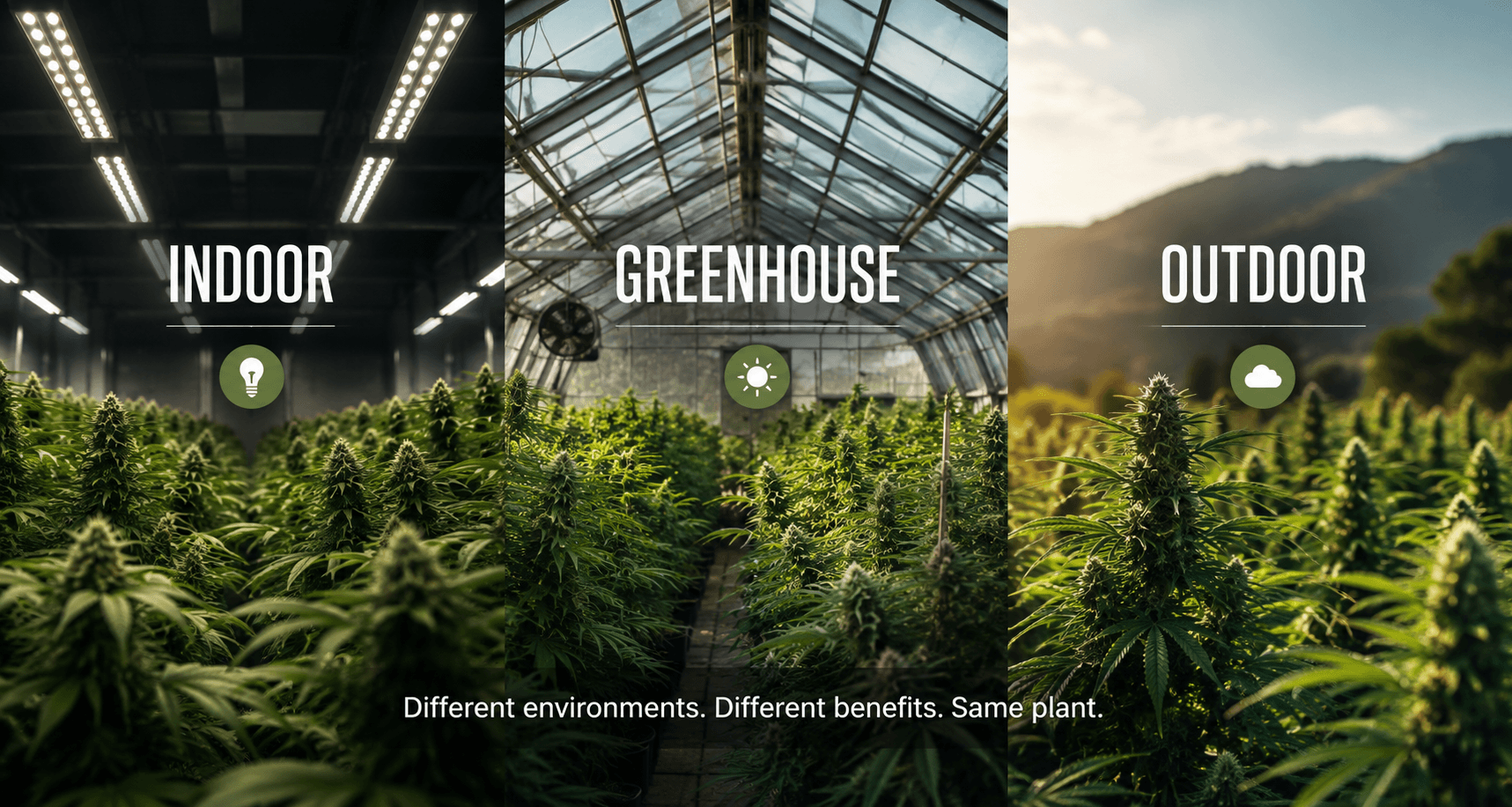
When cannabis is described as indoor, greenhouse or outdoor, the label refers primarily to how and where the plant was cultivated.
These terms provide useful context about the growing environment, but they are not automatic indicators of quality, potency or value. A well-grown outdoor flower may be excellent, while poorly managed indoor cultivation can still produce an inconsistent result.
Understanding the difference helps consumers assess cannabis more realistically.
Indoor Cannabis
Indoor cannabis is cultivated in an enclosed, controlled environment. This may be a dedicated grow room, warehouse facility, converted building or purpose-built production site.
Growers typically use artificial lighting, ventilation, climate-control systems and irrigation equipment to manage the plant’s environment.
What Growers Can Control Indoors
- Light intensity and daily light cycles
- Temperature
- Humidity
- Airflow
- Watering and nutrient delivery
- Pest-management conditions
- Cleanliness and contamination risk
Because conditions can be controlled closely, indoor cultivation can support consistent production throughout the year.
What Indoor Cannabis May Look Like
Indoor flower is often associated with:
- Dense, visually uniform buds
- Strong aroma
- High trichome coverage
- Carefully managed colour and structure
- Consistency between batches
However, appearance alone does not determine quality. Proper drying, curing, genetics, harvesting timing and storage remain equally important.
The Trade-Off
Indoor cultivation can be resource-intensive. Artificial lighting, cooling, dehumidification and ventilation can require significant electricity and infrastructure.
For this reason, indoor cannabis is often more expensive to produce than greenhouse or outdoor cannabis.
Greenhouse Cannabis
Greenhouse cannabis is grown under a structure that uses natural sunlight while offering more environmental protection and control than an open field.
A greenhouse may use glass, polycarbonate panels, plastic sheeting or other materials to create a sheltered growing environment. Depending on the facility, growers may also use supplemental lights, fans, heating, cooling, blackout systems and automated irrigation.
Greenhouse cultivation sits between indoor and outdoor production.
What Makes Greenhouse Growing Different
A greenhouse allows growers to benefit from sunlight while reducing exposure to some external conditions such as heavy rain, wind, pests and extreme temperature changes.
The level of control can vary substantially. A basic greenhouse may provide limited climate management, while a modern commercial greenhouse may use sophisticated systems for light deprivation, irrigation, humidity control and crop monitoring.
Potential Advantages of Greenhouse Cannabis
- Lower energy use than fully indoor growing
- More access to natural sunlight
- Better environmental control than outdoor growing
- Potentially lower production costs
- Longer or more flexible growing seasons
In suitable climates, greenhouse production can provide an efficient balance between consistency and operating cost.
What Consumers Should Know
“Greenhouse” does not describe one fixed quality level. The outcome depends on the facility, genetics, grower skill, crop-management practices, harvest timing and post-harvest handling.
A carefully operated greenhouse can produce high-quality flower, while a poorly managed one may not.
Outdoor Cannabis
Outdoor cannabis is grown in natural conditions, usually in open fields, gardens or agricultural settings.
The plants rely primarily on sunlight and are exposed to seasonal weather patterns. Growers may still use irrigation, soil amendments, protective netting, pest-management programmes and other agricultural techniques, but they have less control over the environment than indoor or greenhouse producers.
What Affects Outdoor Cannabis
- Seasonal temperatures
- Rainfall
- Wind
- Day length
- Soil conditions
- Pests and disease pressure
- Drought or excessive moisture
- Smoke, dust or other environmental contaminants
This makes outdoor cultivation more dependent on location and weather.
Potential Advantages of Outdoor Cultivation
- Lower electricity requirements
- Large-scale cultivation potential
- Natural sunlight exposure
- Lower infrastructure costs
- A smaller operational footprint in some settings
In the right climate and with strong agricultural practices, outdoor cultivation can produce good-quality cannabis at a lower cost.
Common Misconceptions
Outdoor cannabis is sometimes treated as automatically inferior to indoor cannabis. That is too simplistic.
Outdoor flower may look less uniform or more weather-exposed than tightly controlled indoor flower, but quality still depends on the overall production process. Good genetics, healthy plants, careful harvesting, proper drying and curing can all make a substantial difference.
Does Growing Method Determine Potency?
Not by itself.
Cannabinoid levels and terpene profiles are influenced by several factors, including:
- Genetics
- Plant health
- Light exposure
- Nutrient management
- Harvest timing
- Environmental stress
- Drying and curing
- Storage conditions
Indoor cultivation may allow more precise environmental control, but that does not guarantee that every indoor product will have higher THC levels or a better terpene profile than greenhouse or outdoor cannabis.
Lab testing is more useful than marketing labels when comparing potency or cannabinoid content.
Why Curing and Storage Matter as Much as Cultivation
The growing environment is only one part of the production chain.
After harvest, cannabis must be dried and cured carefully. Poor post-harvest handling can reduce aroma, affect texture, create harsh smoke or increase the risk of mould and degradation.
Once packaged, exposure to excessive heat, moisture, oxygen or light can further reduce quality.
A flower grown in an excellent indoor facility can still disappoint if it has been dried poorly or stored incorrectly. Conversely, outdoor flower that has been harvested, cured and stored carefully may perform well.
Which Is Best?
There is no universal answer.
Indoor, greenhouse and outdoor cannabis each involve different trade-offs between environmental control, energy use, scalability, consistency and production cost.
A better question is:
Was the cannabis cultivated, harvested, tested, cured and stored responsibly?
Consumers should look beyond a single “indoor” or “outdoor” label and consider the full picture, including appearance, aroma, freshness, batch information and available lab results.
The Bottom Line
- Indoor cannabis is grown in a controlled enclosed environment using artificial lighting and climate systems.
- Greenhouse cannabis combines natural sunlight with varying levels of environmental control.
- Outdoor cannabis is cultivated in natural seasonal conditions with less direct environmental control.
None of these categories automatically means better or worse cannabis.
The final product depends on genetics, cultivation practices, harvesting, quality control, drying, curing and storage. The cultivation label is useful context, but it should not replace informed evaluation.