
Disclaimer: This article is for general information only and does not constitute legal advice. Cannabis law in South Africa remains subject to legal, regulatory and policy developments. Consult a qualified South African legal professional for advice on a specific situation.
Cannabis law in South Africa has changed substantially, but one distinction remains essential: private use is not the same as a legal recreational retail market.
The Cannabis for Private Purposes Act, 2024 was signed into law in May 2024. However, the Act provides that it comes into operation on a date set by presidential proclamation, and government records have indicated that it is still awaiting proclamation. The Department of Justice published draft regulations for public comment in February 2026, but draft regulations are not final law.
What does “private use” mean?
The legal framework developed from the Constitutional Court’s recognition of adults’ privacy rights in relation to cannabis use, possession and cultivation in private settings.
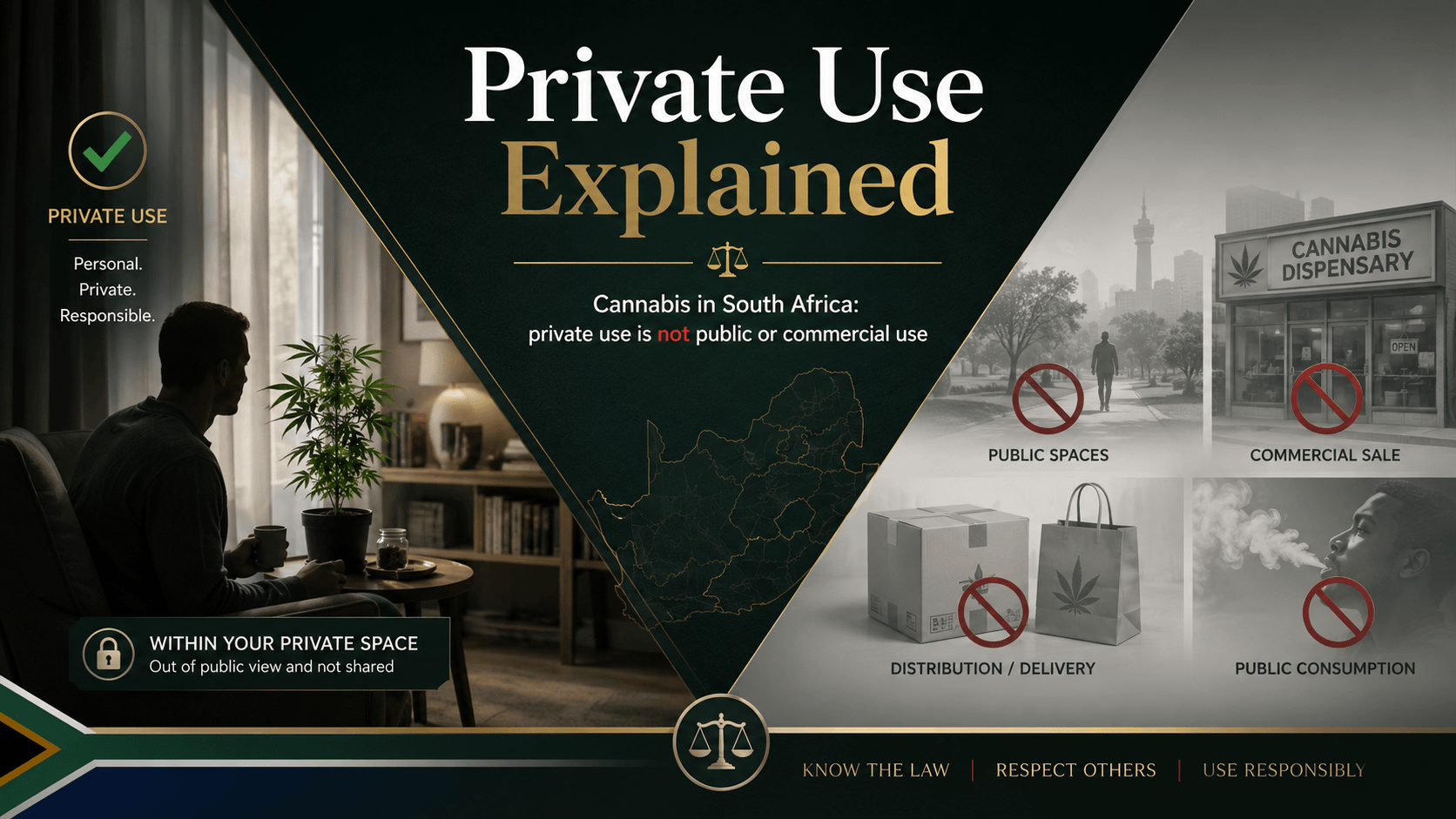
In practical terms, private use refers to cannabis activity by adults for personal purposes in circumstances that remain private. It should not be interpreted as a blanket right to use cannabis anywhere, sell it commercially, or operate an unregulated retail business.
What private use does not allow
Private-use rights should not be confused with permission to:
- sell cannabis as an ordinary commercial product;
- operate a recreational dispensary without an applicable legal basis;
- consume cannabis openly in public spaces;
- expose children to cannabis use; or
- assume that every club, delivery service or cannabis retailer is legally authorised.
The Cannabis for Private Purposes Act is intended to regulate private use and explicitly addresses the prohibition on dealing in cannabis. The commercial cannabis environment remains legally and operationally complex.
What about possession and plant limits?
This is one of the areas where misinformation is common.
In February 2026, the Department of Justice and Constitutional Development published draft Cannabis Regulations for public comment. The draft included proposed limits for possession and cultivation. These proposals should not be described as confirmed or enforceable rules unless they are finalised, published and brought into legal effect.
Until then, consumers and businesses should be cautious about relying on figures circulating online as though they are settled law.
Private does not automatically mean “anything at home”
Privacy is central to the legal position, but context still matters. Cannabis use that affects non-consenting people, creates a public nuisance, involves children, or appears commercial may raise legal concerns.
Being in or near a home does not automatically make every cannabis-related activity lawful. The purpose, setting, people involved and nature of the activity remain relevant.
Can cannabis be transported?
The draft regulatory framework addresses transportation for private purposes. However, detailed rules around quantities and practical handling are linked to regulations that remain in draft form.
A cautious approach is advisable: transport cannabis discreetly, securely and only in circumstances consistent with personal private use. Avoid conduct that could be interpreted as supplying, dealing or distributing cannabis commercially.
What does this mean for dispensaries?
South Africa’s cannabis sector is developing, but the country does not yet have a simple nationwide recreational retail framework comparable to markets in some other jurisdictions.
Private-use protections do not automatically legalise commercial cannabis sales. A dispensary, membership club, delivery platform or cannabis brand should not treat private-use rights as a substitute for a clear legal basis to conduct commercial activity.
Consumers should remain cautious of broad claims such as “fully legal,” “licensed recreational sales,” or “legal nationwide delivery” unless those claims are supported by the relevant legal and regulatory framework.
The bottom line
South African adults have greater protection for cannabis-related private conduct than they did before the Constitutional Court ruling and the subsequent legislation. However, clear boundaries remain.
Private use is not public use.
Private cultivation is not unrestricted commercial production.
Private possession is not the same as a fully legal recreational retail market.
As regulations are finalised and policy around commercialisation develops, it is prudent to follow official government updates rather than relying on social media claims or outdated summaries.
Sources
- South African Government: Cannabis for Private Purposes Act 7 of 2024
- Parliament of South Africa: Cannabis for Private Purposes Act PDF
- Department of Justice: Draft Cannabis Regulations, February 2026
- Department of Justice statement on draft Cannabis Regulations
- Presidency statement: Assent to the Cannabis for Private Purposes Bill